
Label and dose
How to read a certificate of analysis without a chemistry degree
A COA is a useful document and a commonly misunderstood one. Here is what each section proves, and what it deliberately does not.

Brands increasingly publish certificates of analysis, which is progress. Most readers treat them as a general seal of quality. They are something narrower and more useful than that: a record of what one laboratory found in one specific lot.
The short version
- A COA applies to a single lot. If the lot number is not on your bottle, the document does not describe what you bought.
- Identity, assay, and contaminant testing answer three different questions. All three matter.
- A COA produced by the manufacturer's own lab is weaker evidence than one from an independent accredited lab.
- Absence of a contaminant test is not the same as absence of the contaminant.
The four things worth checking first
Lot number. Match it against the bottle. A COA for lot 2411A tells you nothing about lot 2603B. Brands that publish a single COA and leave it up for three years are, at best, being careless.Identity. Does the material test as what it claims to be? This is usually confirmed by a chromatographic or spectroscopic method, and it is the most basic question a COA answers. Adulteration and substitution in botanical raw materials is not rare.Assay. How much of the active compound is actually present, usually as a percentage or milligrams per unit. Compare this against the label claim rather than assuming they agree.Contaminants. Heavy metals, microbial counts, residual solvents, and for botanicals, pesticides. Look at which ones were tested, not just at whether everything passed.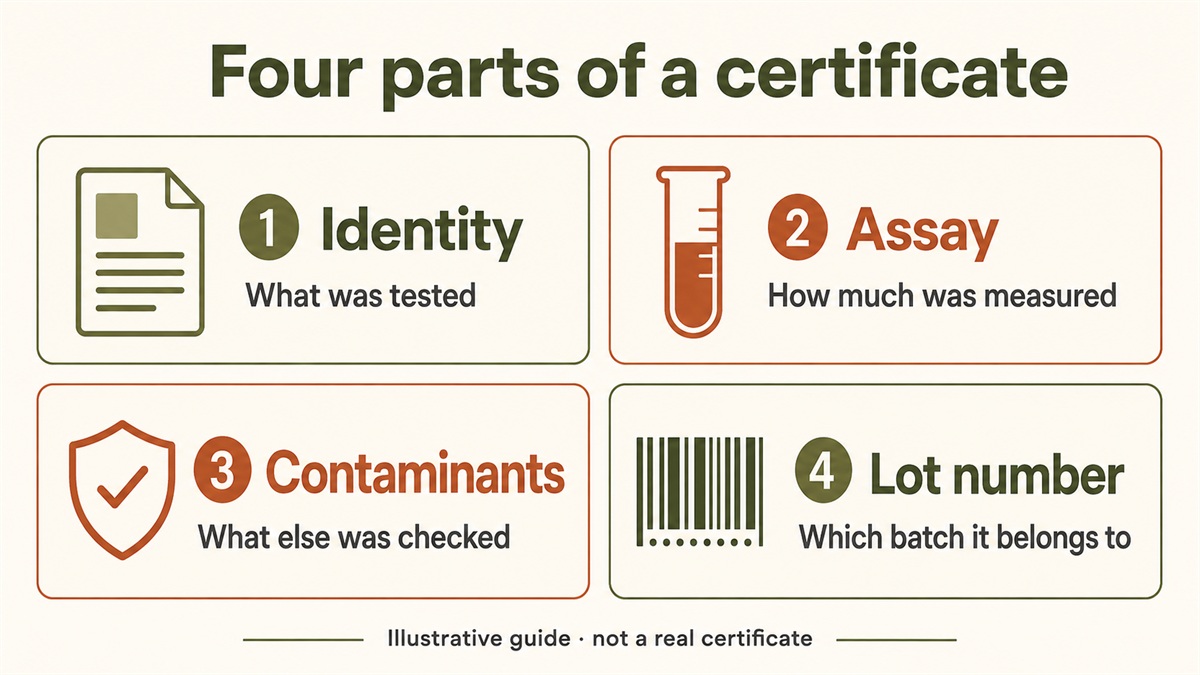
Who did the testing
A COA from the manufacturer's internal quality lab is a legitimate document, and it is not independent. A COA from a third-party laboratory holding ISO 17025 accreditation is materially stronger evidence, because the accreditation covers the lab's competence and method validation, not just its willingness to print a result.
Check that the lab is named and that the accreditation is stated. A document with a logo and no laboratory name is not verifiable and should be treated as marketing.
The gaps that are easy to miss
Tested and passed only tells you about the tests that were run. If a botanical COA has no pesticide panel, that absence is information. If a mineral product has no heavy metal panel, that absence is a bigger one.
Specification limits also matter. Passed against what limit? A generous internal specification can produce a pass that a pharmacopoeial limit would fail. The limit should be printed next to the result.
And a COA says nothing at all about whether the compound works, whether the dose is sensible, or whether it will be absorbed. It is a document about what is in the container.
What good practice looks like
A brand doing this properly publishes a current COA per lot, from a named accredited third-party lab, with specification limits printed alongside results, and makes it easy to look up by the lot number stamped on the bottle.
That is not an unreasonable standard and a growing number of companies meet it. Treat inability or unwillingness to supply a lot-matched COA as an answer in itself.
Test types, plainly
Confirms the material is what it says. Typically HPLC, mass spectrometry, or for botanicals sometimes DNA-based methods. Answers: is this actually the right plant or compound?
Quantifies how much active is present. Answers: does the amount match the label? Watch for results reported as a range or as 'meets specification' without a number.
Heavy metals, microbial limits, residual solvents, pesticides, and for some categories mycotoxins. Answers: is there anything here that should not be? Check the panel, not just the verdict.
Common questions
A brand refused to send me a COA. Is that a red flag?
For a finished consumer product, yes. Lot-level COAs exist for every batch as a matter of routine manufacturing. Refusal is a choice.
Does third-party certification replace a COA?
They answer different questions. Certification programmes audit process and test periodically. A COA describes a specific lot. Ideally you have both.
Sources
- 2026 supplement trends: high-growth categories — https://vitaquest.com/supplement-trends-2026/